
Amazon teaches shoppers to pick one right item

Amazon's AI gives one main pick plus upgrade and budget options.

The AI Revolution:

Business Brief

The One Thing

The one thing I’d like to tell you is that accountability is about to be machine enforced. We are moving from “AI suggests” to “AI decides and releases money.” In the next phase of operations, payment, access, and priority will trigger automatically only if performance is proven. That means politics, storytelling, and creative status updates stop working. Results speak, or the system withholds. Most managers are not prepared for that shift in control.

It changes procurement, service delivery, and headcount planning this quarter. Keep reading this newsletter to stay ahead of it.

Today’s Briefing (Top Stories)

  • Amazon adds AI shopping assistant that recommends main, upgrade, budget picks.
  • Anthropic signs multibillion Google TPU deal for Claude training scale.
  • Microsoft ships Copilot Fall Update with shared workspaces and prepaid credits.

Also in this Issue

  • The Rebel Report: Trust your team, but force traceable accountability.
  • The Tactical Brief: Lock waste in 7 days using a spend control checklist.
  • The Supply Drop: New AI tools you can actually use this week.
  • Dispatch from 2035: In 2035, AI controls vendor payouts through escrow and audit.

Mini-Briefs (Jump to Yours)

TOP STORIES
(Strategic Intel)

Briefing
Amazon Enterprise

Amazon rolls out ‘Help Me Decide’ AI tool

Personalized picks, less decision fatigue, and a push for sticky shopping.
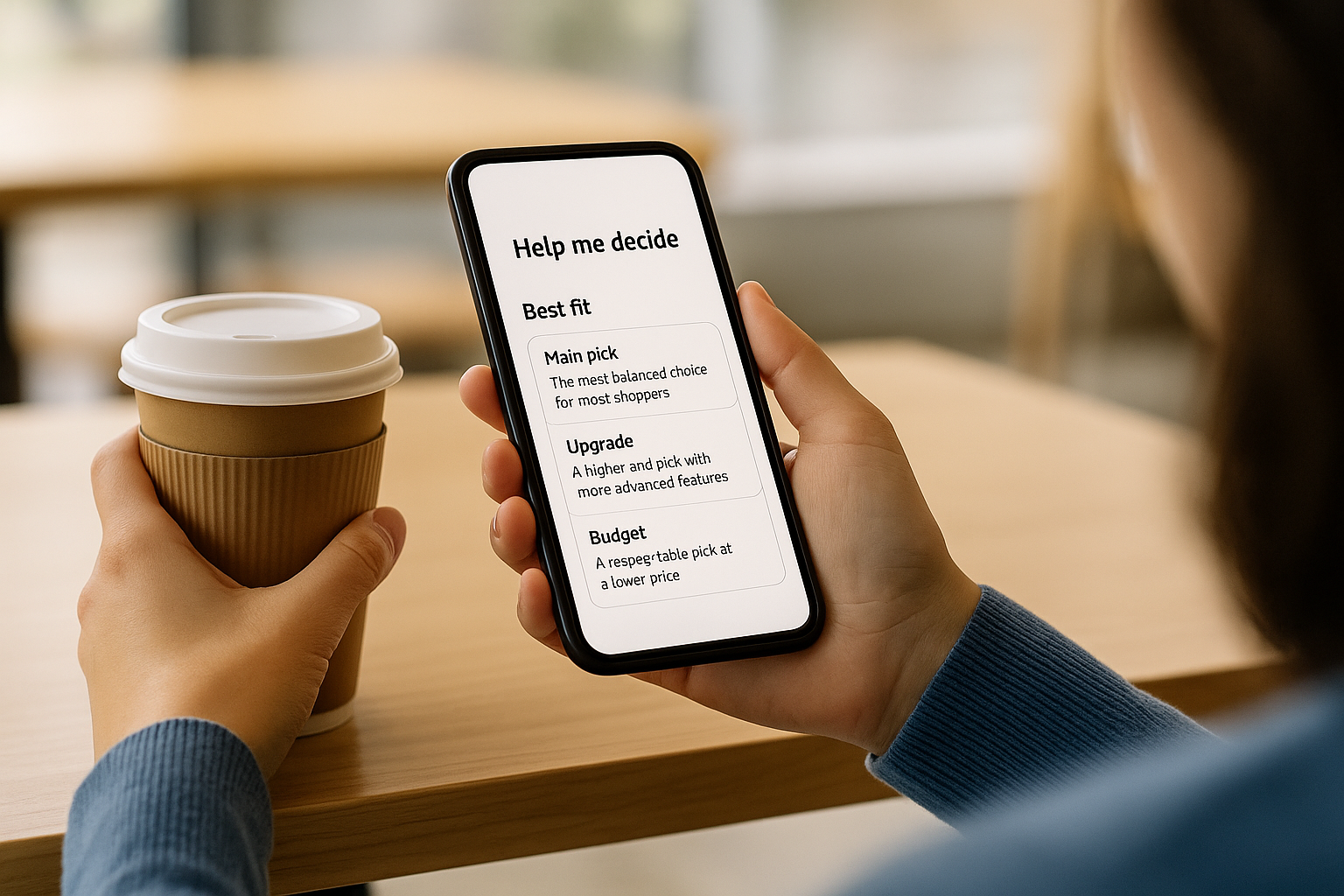
Hand holds a smartphone with a Help Me Decide recommendation screen and buttons, next to a takeaway coffee cup.
Image source: Amazon
The Debrief: Amazon introduced its "Help Me Decide" AI shopping assistant on October 23, 2025, using generative models on its app and mobile web to nudge buyers toward a tailored "best fit" product, targeting friction in online retail.
  • With U.S. launch October 23, 2025, Help Me Decide appears for Amazon shoppers after repeated item browsing cycles.
  • The tool blends OpenSearch and Bedrock’s generative AI to analyze user history, searches, and reviews for context-rich product picks.
  • Amazon’s recommendation logic gives one main suggestion, plus "upgrade" or "budget" options, and is free for app and mobile users.
  • Amazon frames this as a step to simplify shopper choices and fortify platform loyalty against rivals like Walmart and Google (Bloomberg, "new AI-powered tool for indecisive shoppers").
The Takeaway: With up to 600 million product SKUs, Amazon’s “Help Me Decide” confronts the classic paradox of choice, but only adoption rates will reveal if shoppers trust AI with their carts. For e-commerce operators, this could compress churn and lift conversion rates—if recommendations actually stick.
Briefing
Anthropic/Google Data Centers

Anthropic inks multibillion Google chip deal

1 million TPU access, frontier training capacity, and leverage against Nvidia pricing.

Bar chart compares GPT-3 175B training speed on TPU v4 and TPU v5p (bf16, int8), with bars labeled 1.0, 1.9, and 2.8.
Image source: Google Cloud
The Debrief: Anthropic said on October 23, 2025 it will use Google Cloud for up to 1 million TPUs to train Claude under a "tens of billions of dollars" deal, targeting more than 1 gigawatt of capacity in 2026 for frontier compute.
  • On October 23, 2025, Anthropic announced a multiyear Google Cloud deal worth "tens of billions of dollars" to expand Claude training and secure priority access to Google's TPU chips.
  • The partnership gives Anthropic access to up to 1 million Google TPUs and aims for over 1 gigawatt of capacity in 2026 to train and evaluate Claude on Google Cloud.
  • Anthropic said it now serves more than 300,000 business customers and that large accounts grew nearly 7x year over year, arguing that demand justifies the scale of Google's TPU buildout.
  • Google Cloud said the pact proves it can supply compute without Nvidia, and analysts said it could tie Anthropic to Google pricing for years (Reuters, "tens of billions of dollars").
The Takeaway: With Anthropic locking in up to 1 million Google TPUs under a deal worth tens of billions of dollars, raw compute is becoming the new runway for frontier model labs. Yet that volume and the plan for more than 1 gigawatt of new capacity in 2026 effectively tie Claude’s future to Google Cloud’s energy and infrastructure, not a neutral spot market. The takeaway: expect training power to concentrate around a few hyperscalers, and expect pricing leverage on Nvidia class GPUs to soften only for buyers with similar multibillion dollar commitments.
Briefing
Microsoft Agents

Microsoft launches Copilot Fall Update

Shared workspaces, embedded agents, and prepaid Copilot credits.

Copilot wordmark over a soft blue gradient with small daisies in the foreground, used as branding for the fall release.
Image source: Microsoft
The Debrief: Microsoft launched its Copilot Fall Update on October 23, 2025, adding 12 new features and announcing 1,000 monthly Copilot Credits per Dynamics 365 Premium user starting late November 2025, presenting Copilot as an enterprise agent platform across its apps.
  • On October 23, 2025, Microsoft announced the Copilot Fall Update, a package of 12 new features and upgrades that deepen Copilot across Windows, Edge, Microsoft 365, and Dynamics 365.
  • The update introduces shared "Groups" sessions for collaborative prompting, long term memory, cross account Connectors for Gmail and Google Drive, and proactive next step suggestions from recent activity.
  • Microsoft said Dynamics 365 Premium will ship with 1,000 Copilot Credits per user per month starting late November 2025, with extra capacity sold as add ons to meter Copilot usage.
  • Microsoft AI chief Mustafa Suleyman called Copilot "helpful, supportive, and deeply personal" and said Microsoft's MAI models, not OpenAI, will anchor the stack (VentureBeat, "shift from hype to usefulness").
The Takeaway: As Microsoft names 12 Copilot features and bakes credits into Dynamics 365 licenses, the fight shifts from "who has the smartest model" to "who already runs your workflow". Yet most of these agents live inside Microsoft identity, data, and compliance walls, which means rivals cannot easily land without ripping out core systems. Bottom line: the advantage tilts toward organizations already standardized on Microsoft 365 and Dynamics, and everyone else pays a quiet productivity tax to catch up.

THE REBEL REPORT

The Rebel Report

Battle-Tested Wisdom for the War Room

The Voice of Experience

Trust

When I Stopped Jumping In


Half the team stared at their laptops. No one would look up. A report was wrong. Sales had sent it to leadership anyway. My ops lead kept saying, We fixed it. I did not believe her.

My instinct was to grab the numbers myself and redo it in front of everyone. That is what I have always done. Instead, I slid the laptop back and said, Walk me through how you got here. She walked me line by line. The logic held. The data pull was clean. The mistake was upstream, not hers. The room changed. People started talking instead of waiting for me to take the wheel.

This is the new AI trap. You get a perfect answer from a smart system and feel pressure to jump straight to action. Slow down. Ask, Where did this come from. Ask, Who is on the hook if it is wrong. Trust is not blind faith. Trust is traceable work. That is how you stay fast without getting burned.

Takeaway: Respect the person, question the source, and make sure someone owns the result before you move.

THE TACTICAL BRIEF

THE TACTICAL BRIEF

Lock Cost Waste In 7 Days

Cut silent spend without new tools. This checklist gives you a clear owner, a simple log, and a fast path to savings you can measure in real dollars.

Checklist

  1. List the top 10 recurring costs. Done when each has an owner and a monthly dollar amount.
  2. Flag any cost with no active user. Done when you mark idle, shared, or critical for each line.
  3. Freeze all idle costs for 7 days. Done when owners confirm no work is blocked.
  4. Set a cap for shared costs. Done when each shared cost has a monthly spend limit in writing.
  5. Log every new spend request. Done when each request shows problem, cost, and expected return.
  6. Approve new spend only if payback is under 90 days. Done when math is on one line.
  7. Track team overtime hours for this week. Done when you know who is over 45 hours and why.
  8. List work that repeats every day. Done when you name one task you will script or automate first.
  9. Send a daily spend note to leads. Done when each owner knows yesterday's cost change in dollars.
  10. Lock price with each key supplier. Done when you have current unit rate and next review date.
  11. Write a single line on risk for each freeze. Done when you know what breaks if you cut it.
  12. Sum all cuts. Done when you can say this move saves this many dollars per month.
Pro Tips
  • Money talk beats tech talk. Say the dollar burn per week, not the feature name.
  • AI can watch usage. Use it to flag idle seats and slow tickets, not to approve spend.
  • Ask who signs for the bill. The true owner is the person whose budget takes the hit.
Common Pitfalls
  • Cutting a tool before you know who depends on it and killing a revenue task by accident.
  • Letting teams hide spend in petty cash or travel lines instead of the real cost line.
  • Blaming people instead of showing numbers and turning cost control into fear, not clarity.
Use it in 3 minutes
  1. Write your top 5 costs and the owner of each cost on one page.
  2. Circle any cost that no one can defend in one sentence.
  3. Freeze those costs for 7 days and tell the owner to report impact and savings.

THE SUPPLY DROP

🪂 Your high-impact tools from the AI front lines, airlifted to your in-box.
  • 🗣️ Friday – AI voice agent that calls you daily for guided self-reflection journaling
  • 🧠 Amigo AI – Personal finance agent that tracks spending, categorizes transactions, and gives budget advice on iPhone
  • 📸 AI Cleaner by Lilucat – On device photo and video cleanup that finds junk, frees storage, and keeps data private
  • 🧠 Amazon Help Me Decide – In app shopping assistant that recommends one best pick plus upgrade and budget options
  • 🎨 Keepsake – Collaborative family story builder with shared writing, AI ghostwriting prompts, and instant hardcover book layout
  • 🧠 uLuup – AI habit coach that nudges small daily actions, tracks consistency, and builds mindful routines

DISPATCH FROM 2035

Today’s Wild Prediction

Vendors Get Paid Only If the AI Says They Performed

Dispatch From 2035

October 26, 2025

Vendors Get Paid Only If the AI Approves

By 2035, large buyers stop paying vendors on receipt of an invoice. Instead, payment is auto-released from a shared escrow wallet only after an autonomous audit layer confirms that the promised outcome actually happened — uptime delivered, pallets received, response times met. Procurement stops being paperwork and becomes live enforcement.

How it will work:

  • Escrowed Outcome Contracts: Every supplier agreement is written as a machine-readable service contract. The buyer funds an escrow ledger up front for the quarter. Funds are locked, not paid.
  • Autonomous Audit Agents: An internal AI auditor named Lena monitors IoT feeds, delivery scans, facility logs, ticket response timestamps, and SLA clauses. Lena decides if terms were met, line by line, in real time.
  • Conditional Release: When SLAs are hit, Lena triggers partial payment instantly from escrow to the vendor. When SLAs are missed, she withholds that slice, records the breach with evidence, and recommends a credit to future spend instead of a human escalation.
  • Self-Cleaning Vendor Base: A supplier score is continuously updated by an AI vendor risk agent called Arturo. Low performers quietly lose allocation next cycle because they can’t consistently clear audit. High performers get more volume without renegotiation. AP and Procurement become allocation strategy, not invoice chasing.

Why this has a good chance of happening:

  1. Working capital efficiency: Buyers cut average days payable outstanding by double digits because cash is pre-staged, but only released when value is proven. Vendors accept it because payment on success is instant, not net-45.
  2. Fraud and bloat control: Ghost invoices, duplicate billings, and padded labor hours largely disappear because the audit agent only validates observed outcomes, not stated effort.
  3. Procurement headcount shift: The classic buyer role shrinks. The new role is Contract Architect — designing measurable outcomes and acceptable evidence standards the agents can enforce.
  4. Supplier behavior change: Vendors start wiring their own telemetry and proof streams into the buyer’s audit layer to unlock faster cash. Compliance and performance reporting becomes a built-in feature of doing business, not an extra PDF.
Vendors Get Paid Only If the AI Says They Performed

MINI-BRIEFS

Accounting & Finance

Back to top
India centralizes AI fraud defense for payments.

The Reserve Bank of India introduced a national Digital Payments Intelligence Platform on October 21, 2025, using AI to flag fraud patterns across banks and wallets, automatically block suspicious transfers, and coordinate scam response.

Takeaway: India centralizes AI fraud defense for payments.

Workday aims AI directly at finance workflows.

Workday announced new AI agents for finance teams at Workday Rising on October 20, 2025, positioning Workday Assistant to automate planning and reporting workflows and to surface anomalies across ledgers without manual spreadsheet work.

Takeaway: Workday aims AI directly at finance workflows.

PE/VC stack gets integrated AI forecasting.

Dynamo Software released Dynamo v3.0 on October 23, 2025, adding an AI layer for private-market investors that unifies cash-flow forecasting, portfolio analytics, and LP reporting in one platform instead of separate spreadsheets and email threads.

Takeaway: PE/VC stack gets integrated AI forecasting.

AP and payments automation lands inside ERP.

Acumatica announced a partnership with BILL on October 20, 2025, embedding AI-driven accounts payable and payment automation into Acumatica’s ERP so finance teams capture invoices, route approvals, and pay vendors without leaving the system.

Takeaway: AP and payments automation lands inside ERP.

Customer Service & Support

Back to top
Zendesk bakes AI directly into frontline support.

Zendesk introduced October 2025 updates that embed generative AI assistants to draft replies, summarize tickets, and route requests across chat, email, and voice, positioning AI as the default first responder for customer service teams.

Takeaway: Zendesk bakes AI directly into frontline support.

Intercom pushes deeper autonomous customer support.

Intercom released Fin 3 on October 15, 2025, pitching its next-generation AI support agent as capable of answering complex policy questions, escalating when needed, and driving higher self-serve resolution rates without human reps.

Takeaway: Intercom pushes deeper autonomous customer support.

Human Resources & Talent Management

Back to top
Global HR/payroll compliance gets automated forecasting.

Deel announced year-end upgrades on October 23, 2025, adding AI-driven workforce planning, automated multi-country payroll compliance, and unified headcount reporting so HR and finance leaders see hiring, costs, and risk in one global dashboard.

Takeaway: Global HR/payroll compliance gets automated forecasting.

Workday leans on AI to surface internal talent.

[Update] Workday unveiled new AI capabilities for talent management at Workday Rising on October 20, 2025, highlighting skills intelligence and a Workday Assistant to surface internal candidates, guide development, and support managers in real time.

Takeaway: Workday leans on AI to surface internal talent.

IT Operations & Cybersecurity

Back to top
Microsoft moves toward autonomous SOC workflows.

Microsoft introduced Security Copilot Agents on October 21, 2025, extending its generative AI assistant to automate phishing takedowns, lock compromised identities, and orchestrate multi-step incident response across Defender and Sentinel for security operations centers.

Takeaway: Microsoft moves toward autonomous SOC workflows.

CrowdStrike bakes AI guidance into Falcon console.

CrowdStrike unveiled a redesigned Falcon platform interface on October 21, 2025, embedding its Charlotte AI assistant directly into threat hunting and remediation workflows so analysts get guided investigation steps and automated response from one console.

Takeaway: CrowdStrike bakes AI guidance into Falcon console.

ServiceNow pushes shared-data, auto-remediation SecOps.

ServiceNow announced new AI agents for its AI Operations Center on October 18, 2025, saying they unify risk management and security operations data, automate remediation steps, and speed incident response through a shared model.

Takeaway: ServiceNow pushes shared-data, auto-remediation SecOps.

Manufacturing & Production

Back to top
Apple starts U.S. AI server production ahead of schedule.

Apple announced that its 250,000-square-foot AI manufacturing plant in North Houston began limited operations on October 23, 2025, already shipping AI server hardware for Apple Intelligence features and recruiting local talent with Houston Community College.

Takeaway: Apple starts U.S. AI server production ahead of schedule.

Foxconn pairs with Nvidia to scale AI hardware output.

Foxconn announced plans on October 19, 2025, to build AI factory systems with Nvidia’s power infrastructure at its Kaohsiung data center, aiming to scale AI server production and energy-efficient manufacturing for next-generation hardware.

Takeaway: Foxconn pairs with Nvidia to scale AI hardware output.

BMW’s new site is built for AI-first production.

BMW Group announced the opening of its Debrecen plant on September 29, 2025, describing it as an innovative production site built around AI-driven quality control, high automation, and standardized digital workflows for vehicle manufacturing.

Takeaway: BMW’s new site is built for AI-first production.

Procurement & Sourcing

Back to top
Zip tries to automate the full sourcing workflow.

Zip unveiled procurement AI agents at Zip Forward 2025 on October 21, 2025, to automate intake, sourcing, supplier onboarding, and renewals across legal, security, and finance reviews, with the goal of collapsing approval cycle time.

Takeaway: Zip tries to automate the full sourcing workflow.

SAP pushes toward autonomous procurement decisions.

SAP introduced new generative AI features for SAP Ariba and SAP Fieldglass at SAP Spend Connect Live on October 8, 2025, promising autonomous sourcing, real-time supplier risk scoring, and contract insights directly inside procurement workflows.

Takeaway: SAP pushes toward autonomous procurement decisions.

R&D & Product Development

Back to top
PLM gets an embedded engineering copilot layer.

Siemens released Teamcenter 2506 on October 23, 2025, adding GenAI copilots that summarize change requests, answer engineering questions in natural language, and surface PLM data across design, manufacturing, and service via multimodal search.

Takeaway: PLM gets an embedded engineering copilot layer.

Sanofi ties multiple data vendors into one AI R&D stack.

Sanofi announced a partnership with Medidata, Acorn AI, and BC Platforms on October 23, 2025, to build an AI-enabled data environment that speeds trial design, cohort selection, and real-time study analytics across its R&D pipeline.

Takeaway: Sanofi ties multiple data vendors into one AI R&D stack.

Sales & Marketing

Back to top
Amazon bakes AI comparison shopping into the product page.

Amazon introduced ‘Help Me Decide’ on October 23, 2025, an in-app AI shopping feature that recommends a main pick, an upgrade, and a budget option on a single screen to reduce decision friction for buyers.

Takeaway: Amazon bakes AI comparison shopping into the product page.

Copilot moves deeper into seller workflows and CRMs.

Microsoft announced new Copilot for Sales capabilities in its October 2025 release wave, positioning generative AI to draft outreach, summarize CRM activity, and surface next actions for sellers directly inside Dynamics 365 and Salesforce connectors.

Takeaway: Copilot moves deeper into seller workflows and CRMs.

Supply Chain & Logistics

Back to top
Walmart deploys an internal LLM to frontline staff.

Walmart reported that its in-house large language model ‘Sparky’ is assisting more than 1M associates with shelf scanning, price questions, and stock tasks, feeding live data into store and supply chain operations as a daily co-pilot.

Takeaway: Walmart deploys an internal LLM to frontline staff.

Honeywell targets faster picking and reverse logistics with AI.

Honeywell announced AI-enabled workforce and logistics tools at GITEX Dubai on October 16, 2025, including automated stock counting, returns processing, and voice-guided picking aimed at accelerating retail fulfillment and warehouse throughput in distribution centers.

Takeaway: Honeywell targets faster picking and reverse logistics with AI.

LinkedIn Brief Signals from the Frontline

Quick hit from LinkedIn this week. Tap to view the full discussion and comments.

Stay Sharp. Stay Ahead. Stay in the AI Revolution.

Keep pushing forward. The AI revolution won’t wait.

-Dean H. Stanton

NEW BRIEF Under Development

Amazon's AI gives one main pick plus upgrade and budget options.

The AI Revolution:

Business Brief

The One Thing

The one thing I’d like to tell you is that accountability is about to be machine enforced. We are moving from “AI suggests” to “AI decides and releases money.” In the next phase of operations, payment, access, and priority will trigger automatically only if performance is proven. That means politics, storytelling, and creative status updates stop working. Results speak, or the system withholds. Most managers are not prepared for that shift in control.

It changes procurement, service delivery, and headcount planning this quarter. Keep reading this newsletter to stay ahead of it.

Today’s Briefing (Top Stories)

  • Amazon adds AI shopping assistant that recommends main, upgrade, budget picks.
  • Anthropic signs multibillion Google TPU deal for Claude training scale.
  • Microsoft ships Copilot Fall Update with shared workspaces and prepaid credits.

Also in this Issue

  • The Rebel Report: Trust your team, but force traceable accountability.
  • The Tactical Brief: Lock waste in 7 days using a spend control checklist.
  • The Supply Drop: New AI tools you can actually use this week.
  • Dispatch from 2035: In 2035, AI controls vendor payouts through escrow and audit.

Mini-Briefs (Jump to Yours)

TOP STORIES
(Strategic Intel)

Briefing
Amazon Enterprise

Amazon rolls out ‘Help Me Decide’ AI tool

Personalized picks, less decision fatigue, and a push for sticky shopping.

Hand holds a smartphone with a Help Me Decide recommendation screen and buttons, next to a takeaway coffee cup.
Image source: Amazon
The Debrief: Amazon introduced its "Help Me Decide" AI shopping assistant on October 23, 2025, using generative models on its app and mobile web to nudge buyers toward a tailored "best fit" product, targeting friction in online retail.
  • With U.S. launch October 23, 2025, Help Me Decide appears for Amazon shoppers after repeated item browsing cycles.
  • The tool blends OpenSearch and Bedrock’s generative AI to analyze user history, searches, and reviews for context-rich product picks.
  • Amazon’s recommendation logic gives one main suggestion, plus "upgrade" or "budget" options, and is free for app and mobile users.
  • Amazon frames this as a step to simplify shopper choices and fortify platform loyalty against rivals like Walmart and Google (Bloomberg, "new AI-powered tool for indecisive shoppers").
The Takeaway: With up to 600 million product SKUs, Amazon’s “Help Me Decide” confronts the classic paradox of choice, but only adoption rates will reveal if shoppers trust AI with their carts. For e-commerce operators, this could compress churn and lift conversion rates—if recommendations actually stick.
Briefing
Anthropic/Google Data Centers

Anthropic inks multibillion Google chip deal

1 million TPU access, frontier training capacity, and leverage against Nvidia pricing.

Bar chart compares GPT-3 175B training speed on TPU v4 and TPU v5p (bf16, int8), with bars labeled 1.0, 1.9, and 2.8.
Image source: Google Cloud
The Debrief: Anthropic said on October 23, 2025 it will use Google Cloud for up to 1 million TPUs to train Claude under a "tens of billions of dollars" deal, targeting more than 1 gigawatt of capacity in 2026 for frontier compute.
  • On October 23, 2025, Anthropic announced a multiyear Google Cloud deal worth "tens of billions of dollars" to expand Claude training and secure priority access to Google's TPU chips.
  • The partnership gives Anthropic access to up to 1 million Google TPUs and aims for over 1 gigawatt of capacity in 2026 to train and evaluate Claude on Google Cloud.
  • Anthropic said it now serves more than 300,000 business customers and that large accounts grew nearly 7x year over year, arguing that demand justifies the scale of Google's TPU buildout.
  • Google Cloud said the pact proves it can supply compute without Nvidia, and analysts said it could tie Anthropic to Google pricing for years (Reuters, "tens of billions of dollars").
The Takeaway: With Anthropic locking in up to 1 million Google TPUs under a deal worth tens of billions of dollars, raw compute is becoming the new runway for frontier model labs. Yet that volume and the plan for more than 1 gigawatt of new capacity in 2026 effectively tie Claude’s future to Google Cloud’s energy and infrastructure, not a neutral spot market. The takeaway: expect training power to concentrate around a few hyperscalers, and expect pricing leverage on Nvidia class GPUs to soften only for buyers with similar multibillion dollar commitments.
Briefing
Microsoft Agents

Microsoft launches Copilot Fall Update

Shared workspaces, embedded agents, and prepaid Copilot credits.

Copilot wordmark over a soft blue gradient with small daisies in the foreground, used as branding for the fall release.
Image source: Microsoft
The Debrief: Microsoft launched its Copilot Fall Update on October 23, 2025, adding 12 new features and announcing 1,000 monthly Copilot Credits per Dynamics 365 Premium user starting late November 2025, presenting Copilot as an enterprise agent platform across its apps.
  • On October 23, 2025, Microsoft announced the Copilot Fall Update, a package of 12 new features and upgrades that deepen Copilot across Windows, Edge, Microsoft 365, and Dynamics 365.
  • The update introduces shared "Groups" sessions for collaborative prompting, long term memory, cross account Connectors for Gmail and Google Drive, and proactive next step suggestions from recent activity.
  • Microsoft said Dynamics 365 Premium will ship with 1,000 Copilot Credits per user per month starting late November 2025, with extra capacity sold as add ons to meter Copilot usage.
  • Microsoft AI chief Mustafa Suleyman called Copilot "helpful, supportive, and deeply personal" and said Microsoft's MAI models, not OpenAI, will anchor the stack (VentureBeat, "shift from hype to usefulness").
The Takeaway: As Microsoft names 12 Copilot features and bakes credits into Dynamics 365 licenses, the fight shifts from "who has the smartest model" to "who already runs your workflow". Yet most of these agents live inside Microsoft identity, data, and compliance walls, which means rivals cannot easily land without ripping out core systems. Bottom line: the advantage tilts toward organizations already standardized on Microsoft 365 and Dynamics, and everyone else pays a quiet productivity tax to catch up.

THE REBEL REPORT

The Rebel Report

Battle-Tested Wisdom for the War Room

The Voice of Experience

Trust

When I Stopped Jumping In


Half the team stared at their laptops. No one would look up. A report was wrong. Sales had sent it to leadership anyway. My ops lead kept saying, We fixed it. I did not believe her.

My instinct was to grab the numbers myself and redo it in front of everyone. That is what I have always done. Instead, I slid the laptop back and said, Walk me through how you got here. She walked me line by line. The logic held. The data pull was clean. The mistake was upstream, not hers. The room changed. People started talking instead of waiting for me to take the wheel.

This is the new AI trap. You get a perfect answer from a smart system and feel pressure to jump straight to action. Slow down. Ask, Where did this come from. Ask, Who is on the hook if it is wrong. Trust is not blind faith. Trust is traceable work. That is how you stay fast without getting burned.

Takeaway: Respect the person, question the source, and make sure someone owns the result before you move.

THE TACTICAL BRIEF

THE TACTICAL BRIEF

Lock Cost Waste In 7 Days

Cut silent spend without new tools. This checklist gives you a clear owner, a simple log, and a fast path to savings you can measure in real dollars.

Checklist

  1. List the top 10 recurring costs. Done when each has an owner and a monthly dollar amount.
  2. Flag any cost with no active user. Done when you mark idle, shared, or critical for each line.
  3. Freeze all idle costs for 7 days. Done when owners confirm no work is blocked.
  4. Set a cap for shared costs. Done when each shared cost has a monthly spend limit in writing.
  5. Log every new spend request. Done when each request shows problem, cost, and expected return.
  6. Approve new spend only if payback is under 90 days. Done when math is on one line.
  7. Track team overtime hours for this week. Done when you know who is over 45 hours and why.
  8. List work that repeats every day. Done when you name one task you will script or automate first.
  9. Send a daily spend note to leads. Done when each owner knows yesterday's cost change in dollars.
  10. Lock price with each key supplier. Done when you have current unit rate and next review date.
  11. Write a single line on risk for each freeze. Done when you know what breaks if you cut it.
  12. Sum all cuts. Done when you can say this move saves this many dollars per month.
Pro Tips
  • Money talk beats tech talk. Say the dollar burn per week, not the feature name.
  • AI can watch usage. Use it to flag idle seats and slow tickets, not to approve spend.
  • Ask who signs for the bill. The true owner is the person whose budget takes the hit.
Common Pitfalls
  • Cutting a tool before you know who depends on it and killing a revenue task by accident.
  • Letting teams hide spend in petty cash or travel lines instead of the real cost line.
  • Blaming people instead of showing numbers and turning cost control into fear, not clarity.
Use it in 3 minutes
  1. Write your top 5 costs and the owner of each cost on one page.
  2. Circle any cost that no one can defend in one sentence.
  3. Freeze those costs for 7 days and tell the owner to report impact and savings.

THE SUPPLY DROP

🪂 Your high-impact tools from the AI front lines, airlifted to your in-box.
  • 🗣️ Friday – AI voice agent that calls you daily for guided self-reflection journaling
  • 🧠 Amigo AI – Personal finance agent that tracks spending, categorizes transactions, and gives budget advice on iPhone
  • 📸 AI Cleaner by Lilucat – On device photo and video cleanup that finds junk, frees storage, and keeps data private
  • 🧠 Amazon Help Me Decide – In app shopping assistant that recommends one best pick plus upgrade and budget options
  • 🎨 Keepsake – Collaborative family story builder with shared writing, AI ghostwriting prompts, and instant hardcover book layout
  • 🧠 uLuup – AI habit coach that nudges small daily actions, tracks consistency, and builds mindful routines

DISPATCH FROM 2035

Today’s Wild Prediction

Vendors Get Paid Only If the AI Says They Performed

Dispatch From 2035

October 26, 2025

Vendors Get Paid Only If the AI Approves

By 2035, large buyers stop paying vendors on receipt of an invoice. Instead, payment is auto-released from a shared escrow wallet only after an autonomous audit layer confirms that the promised outcome actually happened — uptime delivered, pallets received, response times met. Procurement stops being paperwork and becomes live enforcement.

How it will work:

  • Escrowed Outcome Contracts: Every supplier agreement is written as a machine-readable service contract. The buyer funds an escrow ledger up front for the quarter. Funds are locked, not paid.
  • Autonomous Audit Agents: An internal AI auditor named Lena monitors IoT feeds, delivery scans, facility logs, ticket response timestamps, and SLA clauses. Lena decides if terms were met, line by line, in real time.
  • Conditional Release: When SLAs are hit, Lena triggers partial payment instantly from escrow to the vendor. When SLAs are missed, she withholds that slice, records the breach with evidence, and recommends a credit to future spend instead of a human escalation.
  • Self-Cleaning Vendor Base: A supplier score is continuously updated by an AI vendor risk agent called Arturo. Low performers quietly lose allocation next cycle because they can’t consistently clear audit. High performers get more volume without renegotiation. AP and Procurement become allocation strategy, not invoice chasing.

Why this has a good chance of happening:

  1. Working capital efficiency: Buyers cut average days payable outstanding by double digits because cash is pre-staged, but only released when value is proven. Vendors accept it because payment on success is instant, not net-45.
  2. Fraud and bloat control: Ghost invoices, duplicate billings, and padded labor hours largely disappear because the audit agent only validates observed outcomes, not stated effort.
  3. Procurement headcount shift: The classic buyer role shrinks. The new role is Contract Architect — designing measurable outcomes and acceptable evidence standards the agents can enforce.
  4. Supplier behavior change: Vendors start wiring their own telemetry and proof streams into the buyer’s audit layer to unlock faster cash. Compliance and performance reporting becomes a built-in feature of doing business, not an extra PDF.
Vendors Get Paid Only If the AI Says They Performed

MINI-BRIEFS

Accounting & Finance

Back to top
India centralizes AI fraud defense for payments.

The Reserve Bank of India introduced a national Digital Payments Intelligence Platform on October 21, 2025, using AI to flag fraud patterns across banks and wallets, automatically block suspicious transfers, and coordinate scam response.

Takeaway: India centralizes AI fraud defense for payments.

Workday aims AI directly at finance workflows.

Workday announced new AI agents for finance teams at Workday Rising on October 20, 2025, positioning Workday Assistant to automate planning and reporting workflows and to surface anomalies across ledgers without manual spreadsheet work.

Takeaway: Workday aims AI directly at finance workflows.

PE/VC stack gets integrated AI forecasting.

Dynamo Software released Dynamo v3.0 on October 23, 2025, adding an AI layer for private-market investors that unifies cash-flow forecasting, portfolio analytics, and LP reporting in one platform instead of separate spreadsheets and email threads.

Takeaway: PE/VC stack gets integrated AI forecasting.

AP and payments automation lands inside ERP.

Acumatica announced a partnership with BILL on October 20, 2025, embedding AI-driven accounts payable and payment automation into Acumatica’s ERP so finance teams capture invoices, route approvals, and pay vendors without leaving the system.

Takeaway: AP and payments automation lands inside ERP.

Customer Service & Support

Back to top
Zendesk bakes AI directly into frontline support.

Zendesk introduced October 2025 updates that embed generative AI assistants to draft replies, summarize tickets, and route requests across chat, email, and voice, positioning AI as the default first responder for customer service teams.

Takeaway: Zendesk bakes AI directly into frontline support.

Intercom pushes deeper autonomous customer support.

Intercom released Fin 3 on October 15, 2025, pitching its next-generation AI support agent as capable of answering complex policy questions, escalating when needed, and driving higher self-serve resolution rates without human reps.

Takeaway: Intercom pushes deeper autonomous customer support.

Human Resources & Talent Management

Back to top
Global HR/payroll compliance gets automated forecasting.

Deel announced year-end upgrades on October 23, 2025, adding AI-driven workforce planning, automated multi-country payroll compliance, and unified headcount reporting so HR and finance leaders see hiring, costs, and risk in one global dashboard.

Takeaway: Global HR/payroll compliance gets automated forecasting.

Workday leans on AI to surface internal talent.

[Update] Workday unveiled new AI capabilities for talent management at Workday Rising on October 20, 2025, highlighting skills intelligence and a Workday Assistant to surface internal candidates, guide development, and support managers in real time.

Takeaway: Workday leans on AI to surface internal talent.

IT Operations & Cybersecurity

Back to top
Microsoft moves toward autonomous SOC workflows.

Microsoft introduced Security Copilot Agents on October 21, 2025, extending its generative AI assistant to automate phishing takedowns, lock compromised identities, and orchestrate multi-step incident response across Defender and Sentinel for security operations centers.

Takeaway: Microsoft moves toward autonomous SOC workflows.

CrowdStrike bakes AI guidance into Falcon console.

CrowdStrike unveiled a redesigned Falcon platform interface on October 21, 2025, embedding its Charlotte AI assistant directly into threat hunting and remediation workflows so analysts get guided investigation steps and automated response from one console.

Takeaway: CrowdStrike bakes AI guidance into Falcon console.

ServiceNow pushes shared-data, auto-remediation SecOps.

ServiceNow announced new AI agents for its AI Operations Center on October 18, 2025, saying they unify risk management and security operations data, automate remediation steps, and speed incident response through a shared model.

Takeaway: ServiceNow pushes shared-data, auto-remediation SecOps.

Manufacturing & Production

Back to top
Apple starts U.S. AI server production ahead of schedule.

Apple announced that its 250,000-square-foot AI manufacturing plant in North Houston began limited operations on October 23, 2025, already shipping AI server hardware for Apple Intelligence features and recruiting local talent with Houston Community College.

Takeaway: Apple starts U.S. AI server production ahead of schedule.

Foxconn pairs with Nvidia to scale AI hardware output.

Foxconn announced plans on October 19, 2025, to build AI factory systems with Nvidia’s power infrastructure at its Kaohsiung data center, aiming to scale AI server production and energy-efficient manufacturing for next-generation hardware.

Takeaway: Foxconn pairs with Nvidia to scale AI hardware output.

BMW’s new site is built for AI-first production.

BMW Group announced the opening of its Debrecen plant on September 29, 2025, describing it as an innovative production site built around AI-driven quality control, high automation, and standardized digital workflows for vehicle manufacturing.

Takeaway: BMW’s new site is built for AI-first production.

Procurement & Sourcing

Back to top
Zip tries to automate the full sourcing workflow.

Zip unveiled procurement AI agents at Zip Forward 2025 on October 21, 2025, to automate intake, sourcing, supplier onboarding, and renewals across legal, security, and finance reviews, with the goal of collapsing approval cycle time.

Takeaway: Zip tries to automate the full sourcing workflow.

SAP pushes toward autonomous procurement decisions.

SAP introduced new generative AI features for SAP Ariba and SAP Fieldglass at SAP Spend Connect Live on October 8, 2025, promising autonomous sourcing, real-time supplier risk scoring, and contract insights directly inside procurement workflows.

Takeaway: SAP pushes toward autonomous procurement decisions.

R&D & Product Development

Back to top
PLM gets an embedded engineering copilot layer.

Siemens released Teamcenter 2506 on October 23, 2025, adding GenAI copilots that summarize change requests, answer engineering questions in natural language, and surface PLM data across design, manufacturing, and service via multimodal search.

Takeaway: PLM gets an embedded engineering copilot layer.

Sanofi ties multiple data vendors into one AI R&D stack.

Sanofi announced a partnership with Medidata, Acorn AI, and BC Platforms on October 23, 2025, to build an AI-enabled data environment that speeds trial design, cohort selection, and real-time study analytics across its R&D pipeline.

Takeaway: Sanofi ties multiple data vendors into one AI R&D stack.

Sales & Marketing

Back to top
Amazon bakes AI comparison shopping into the product page.

Amazon introduced ‘Help Me Decide’ on October 23, 2025, an in-app AI shopping feature that recommends a main pick, an upgrade, and a budget option on a single screen to reduce decision friction for buyers.

Takeaway: Amazon bakes AI comparison shopping into the product page.

Copilot moves deeper into seller workflows and CRMs.

Microsoft announced new Copilot for Sales capabilities in its October 2025 release wave, positioning generative AI to draft outreach, summarize CRM activity, and surface next actions for sellers directly inside Dynamics 365 and Salesforce connectors.

Takeaway: Copilot moves deeper into seller workflows and CRMs.

Supply Chain & Logistics

Back to top
Walmart deploys an internal LLM to frontline staff.

Walmart reported that its in-house large language model ‘Sparky’ is assisting more than 1M associates with shelf scanning, price questions, and stock tasks, feeding live data into store and supply chain operations as a daily co-pilot.

Takeaway: Walmart deploys an internal LLM to frontline staff.

Honeywell targets faster picking and reverse logistics with AI.

Honeywell announced AI-enabled workforce and logistics tools at GITEX Dubai on October 16, 2025, including automated stock counting, returns processing, and voice-guided picking aimed at accelerating retail fulfillment and warehouse throughput in distribution centers.

Takeaway: Honeywell targets faster picking and reverse logistics with AI.

LinkedIn Brief Signals from the Frontline

Quick hit from LinkedIn this week. Tap to view the full discussion and comments.

Stay Sharp. Stay Ahead. Stay in the AI Revolution.

Keep pushing forward. The AI revolution won’t wait.

-Dean H. Stanton